
Can AI developers take advantage of Oracle Database 26ai?

Under the hood, Oracle Database 26ai is technically the same release family as 23ai (it's RU 23.26), but Oracle renamed it to signal that they've fundamentally moved from adding AI features to adopting an AI-native architecture.
But if you look past the name change, there's something more interesting happening here. Oracle isn't just adding a "vector" data type and calling it a day. They're trying to solve the biggest headache in modern AI development: data gravity.
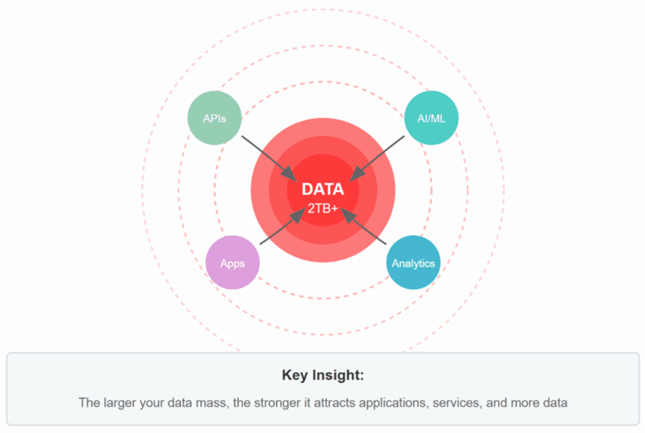
Data gravity refers to how large collections of data naturally pull in applications, services, and even more data. Just like physical gravity increases with mass, the "pull" grows as the data volume grows. Data lakes and data warehouses are common examples of environments where data gravity occurs.
The following figure (borrowed from here), demonstrates how the larger the data, the more it attracts applications, services, and more data.
Furthermore, of the many advantages that Oracle Database 26ai offers for modern day developers, some include:
- JSON-Relational Duality: Oracle Database 26ai treats vectors, JSON, and relational data as the same thing. You can store data as rows (for the DBAs) but fetch and update them as JSON documents (for the frontend). There is no need for object-relationship mapping anymore.
- Built-in LLM Integration: With 26ai, you can call an LLM directly via SQL. You can literally run a query that says, "Find me the top 5 customers, and summarize their last three support tickets," and the database handles the RAG pipeline internally.
- The "Zero-Upgrade" Upgrade: One thing the AI-generated blogs miss is that 26ai is delivered as a Release Update (RU). If you’re on 23ai, you just patch.
The "Old" Way We Build AI Apps Right Now
As AI developers, most of us have spent the last year building RAG (Retrieval-Augmented Generation) pipelines like this:
- Export data from our "source of truth" (Oracle Database).
- Push it through an ETL pipeline.
- Index it in a separate vector database (Pinecone, Weaviate, etc.).
- Hope the two stay in sync.
It’s brittle, it’s expensive, and it’s a security nightmare.
Developing with Oracle Database 26ai
Now take a look at the following figure. Oracle is moving reasoning (such as AI agents and vector search) away from the application tier and into the data layer.
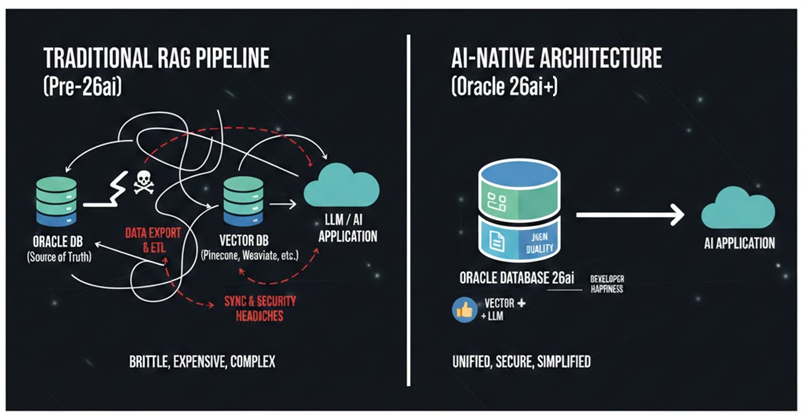
This is one of the problems that Oracle is trying to solve for the modern day AI developer... by providing a simplified, unified, and secure platform for AI development.
If you’re still on 19c, skip 23ai and head straight for 26ai. The water's fine, and you can finally stop managing that separate vector database.